
Elektron Octatrack MKII – Manual and Overview

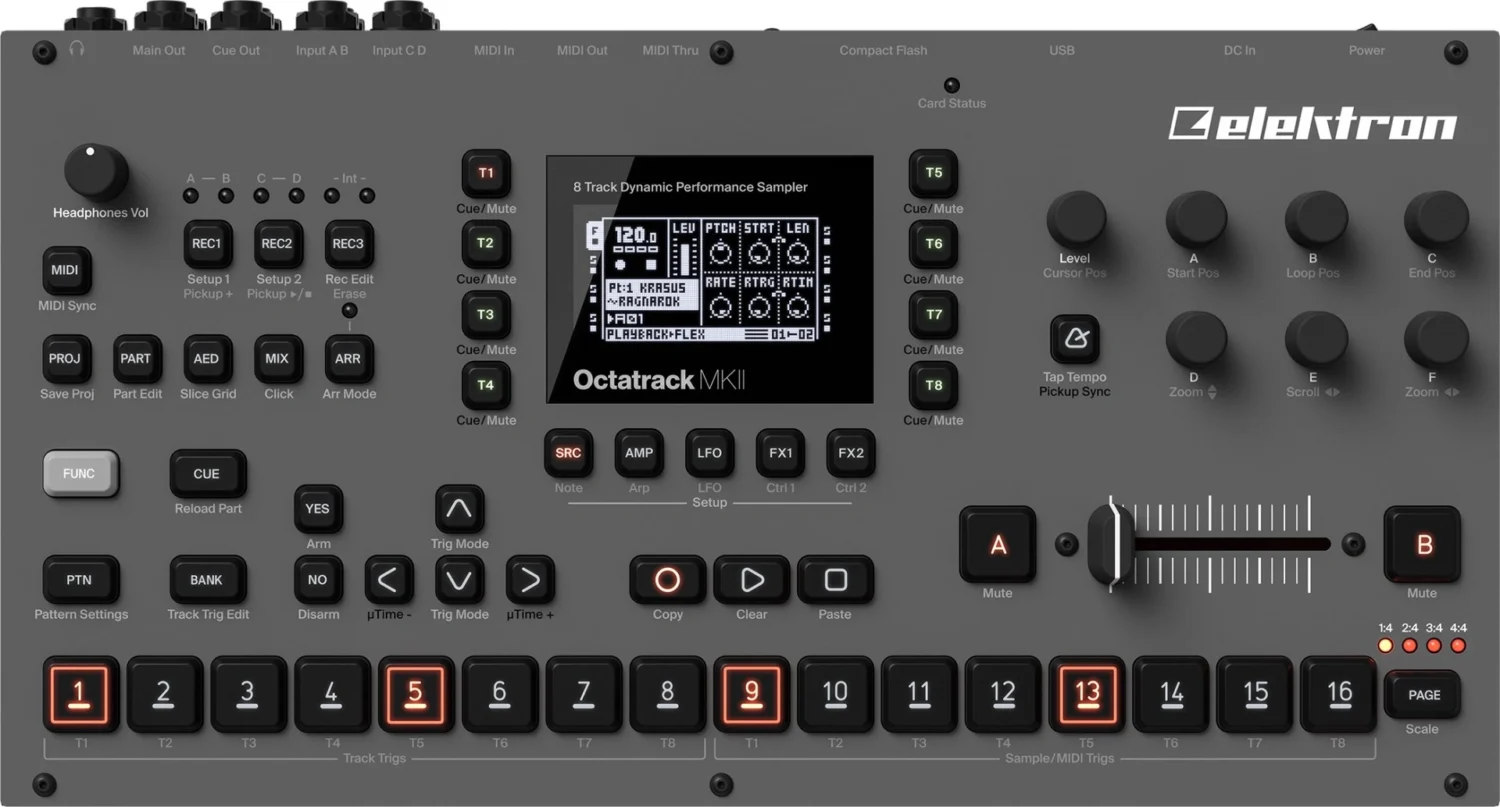
The Elektron Octatrack MKII sits in that strange, rare zone where a sampler stops feeling like a simple playback box and starts acting more like the nerve center of an entire live setup. Elektron frames it as an eight-track dynamic performance sampler and sequencer, and that description fits because the machine can handle sample playback, live resampling, loop manipulation, MIDI sequencing, and performance control from one piece of hardware. It stores projects on CompactFlash, gives you 80 MB of Flex RAM per project, supports Static machines that stream samples from the card, and offers deep pattern-based sequencing with up to 256 patterns per project.
What makes the Octatrack MKII matter to electronic musicians is not just the spec sheet. It is the way it encourages performance as composition. You can grab incoming audio, chop it, pitch it, retrigger it, run it through effects, and then morph whole scenes with the crossfader in a way that feels physical and immediate. That is where the machine earns its reputation. A lot of samplers are good at holding sounds. The Octatrack is good at turning those sounds into a moving system. It rewards people who think in patterns, transitions, tension, and controlled chaos, whether they are building techno sets, ambient collages, broken beat experiments, or full live remix workflows. Elektron’s own documentation also leans hard into scene assignment, parts, and pattern performance, which tells you a lot about how the instrument is meant to be played.
The MKII version also has the kind of practical hardware details that matter once you actually live with a machine. Elektron lists OLED screen hardware, dedicated audio and MIDI connectivity, CF card storage, and a 12 VDC power requirement with a 2 A minimum current rating on the official support page. On paper those details look dry, but in practice they matter because the Octatrack tends to become a long-term studio and stage companion rather than a weekend novelty. People keep one around because it can serve as a performance mixer, sample mangler, phrase looper, backing track brain, and MIDI command center all at once. It asks for commitment, but it gives back a workflow that feels personal once it clicks.
Key Features
- Eight audio tracks with flexible machine types (Flex, Static, Thru, Neighbor)
- Real-time sampling and live resampling from external inputs or internal audio
- 80 MB RAM per project for Flex machines; CompactFlash streaming for large samples via Static machines
- Elektron sequencer with parameter locks, micro-timing, retrigs, and conditional trigs
- Scene system with assignable crossfader for morphing multiple parameters at once
- Eight dedicated MIDI tracks for sequencing external gear
- Built-in effects per track (filters, EQ, delay, reverb, lo-fi, chorus, flanger, etc.)
- Time-stretching and pitch-shifting with tempo-synced playback
- Slicing and sample chain support for complex sample manipulation
- Multiple inputs for routing external gear through the Octatrack as a mixer/effects processor
- Cue outputs for pre-listening or separate signal routing
- Parts system for switching between different machine/sample configurations within a bank
- Pattern-based workflow with up to 256 patterns per project
- CompactFlash storage for projects, samples, and backups
- OLED screen and improved encoders/buttons (MKII hardware revision)
- MIDI in/out/thru for full integration with external setups
- Rugged metal enclosure built for live performance