

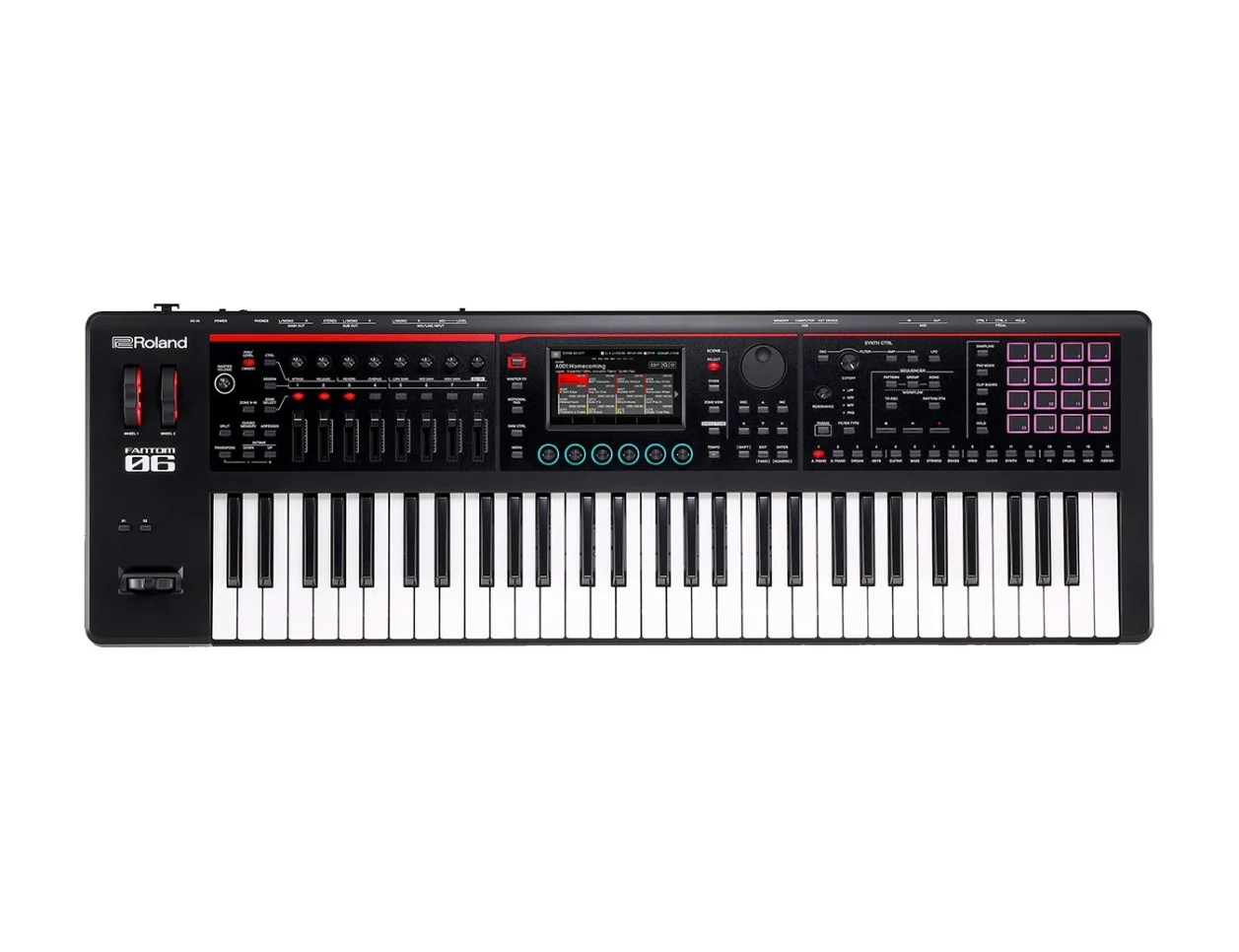
Roland FANTOM-06 – Manual and Overview

The Roland FANTOM-06 takes a lot of what made the larger FANTOM instruments interesting and puts it into a lighter 61-key workstation that makes considerably more sense for a small studio or a setup that actually has to leave the house. It is the kind of keyboard that can cover a lot of territory without making every job feel like an afterthought. ZEN-Core handles the broad electronic side of the machine, while Roland’s SuperNATURAL engines take care of acoustic and electric pianos and other more traditional instruments. There is also a Virtual ToneWheel organ engine, so moving from a synthetic pad or bass into an organ or piano sound does not require another keyboard sitting beside it.
For electronic music, ZEN-Core is probably where the FANTOM-06 becomes most interesting. There are thousands of tones onboard, but the useful part is how much access you have to the sound once you start working with it. The front panel gives you dedicated controls alongside eight knobs and eight sliders, and the 5.5-inch touchscreen becomes the center of the deeper editing and sequencing work. You can stack and split sounds across 16 zones, build fairly elaborate performance setups, and save the whole arrangement as a Scene. That makes it easy to create one environment where a bass lives at the bottom of the keyboard, a pad sits above it, an external synth occupies another zone, and the sequencer is handling a separate group of parts in the background.
The sequencing side feels distinctly Roland. There are 16 MIDI tracks with eight patterns available on each track, and recording can be handled in real time, through step entry, or with the TR-REC method inherited from Roland’s drum machines. Patterns can extend to 64 measures, and the touchscreen gives you a piano-roll editor when you need to get more surgical about notes and automation. The 4×4 pad section also gets used for much more than finger drumming; depending on the mode, the pads can trigger samples, patterns, groups, rhythm patterns, notes, or control functions around the rest of the machine. It gives the FANTOM-06 a workflow that can move between playing a keyboard and constructing a track without constantly reaching for a computer.
Sampling expands that idea considerably. The FANTOM-06 has both keyboard multisampling and a separate pad sampler, so imported or recorded audio can become either an instrument spread across the keys or material triggered from the pads. External audio can come in through the line or microphone inputs, with the latter also feeding the onboard vocoder. There is a substantial effects section, separate main and sub outputs, and USB audio/MIDI that allows the keyboard to function as a multichannel audio interface with a computer. At around 13 pounds, it is also unusually manageable for something that can handle this much of a studio on its own. The FANTOM-06 makes the most sense for musicians who want a keyboard to remain a keyboard while still having sampling, sequencing, synthesis, and production tools close enough to become part of the instrument itself.
Key Features
- 61-note velocity-sensitive synth-action keyboard
- ZEN-Core synthesis engine
- SuperNATURAL Acoustic sound engine
- SuperNATURAL acoustic and electric piano engines
- Virtual ToneWheel organ engine
- More than 3,500 onboard tones and 90+ drum kits
- 16 internal/external zones for splits, layers, and MIDI control
- 512 Scene locations across four banks
- 16-track pattern sequencer
- Eight patterns available per sequencer track
- Patterns up to 64 measures in length
- Real-time, step, and TR-REC sequencing
- Touchscreen piano-roll and automation editing
- Keyboard multisampling with WAV and AIFF support
- 16-pad sampler with four sample banks
- 4×4 RGB performance pad section
- 5.5-inch color touchscreen
- Eight assignable control knobs and eight sliders
- Extensive onboard multi-effects, chorus, reverb, compression, and EQ
- Microphone input with onboard vocoder
- Stereo line inputs plus main and separate sub outputs
- USB audio and MIDI connectivity
- Up to 24-bit/96 kHz USB audio operation
- Roland Cloud support for Model Expansions, Sound Packs, Sample Packs, and Wave Expansions
- Arpeggiator, chord memory, rhythm patterns, and Motional Pad
- MIDI In and Out for sequencing and controlling external hardware
- Approximately 13.2 lb / 6 kg total weight